
a zine-maker is normal about fiber arts
kseniya yarosh on one stitch after another
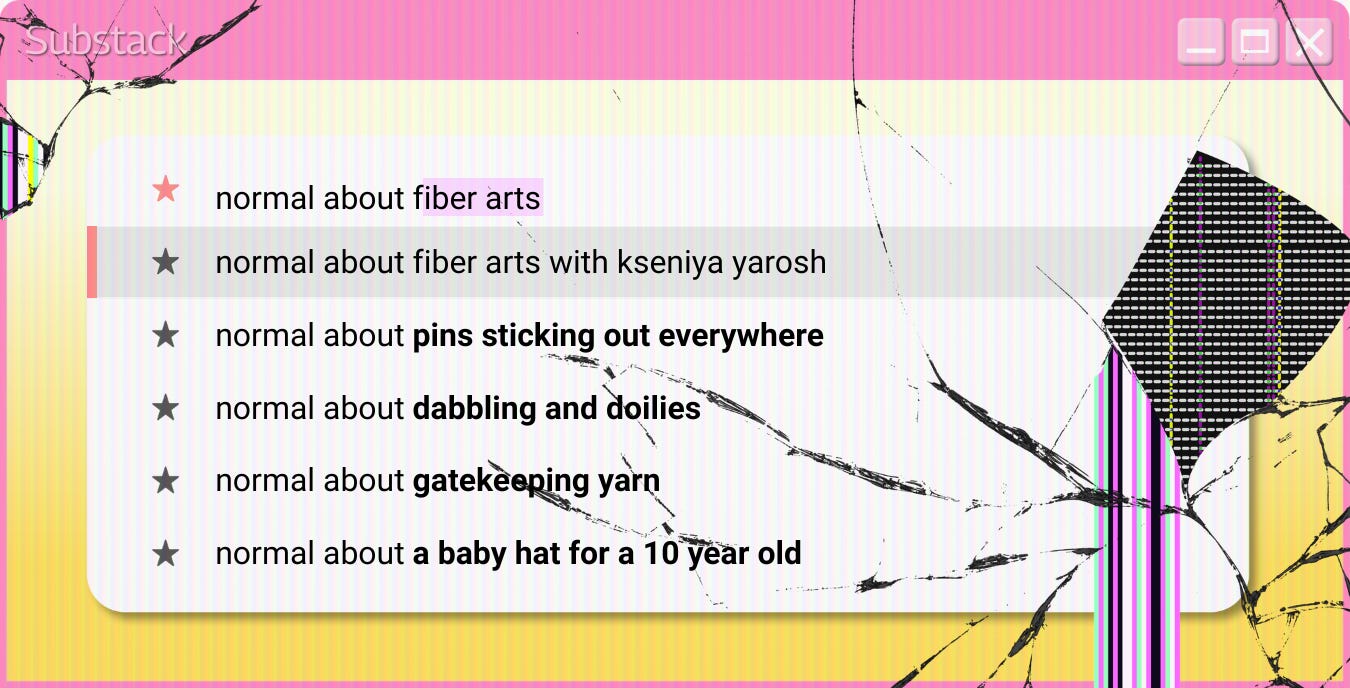
Kseniya Yarosh is a zine-maker, former podcaster, and current customer support specialist. Today, she’s feeling normal about fiber arts, in the aggregate — the process of turning threads into stitches into cherished objects (or haunting reminders, depending on how your project is going…). From embroidery to crocheting to a sweaty attempt at weaving, Kseniya believes strongly in the transformative power of Making Stuff. TL;DR: forget grass, touch yarn.
This interview has been edited for clarity, coherence, and vibes.
JADIE: What are you feeling normal about, and how did you first encounter it?
KSENIYA: I’m feeling totally normal about fiber arts. It’s something I do or think about every day, sometimes multiple times a day. Anything to do with thread, fabric, yarn, embroidery, doilies, weird little clown cross stitches in the corner of the antique store — that’s all for me.
I have a very vivid memory of a cross stitch on the wall behind the couch at my grandparents’ house. It was so beautiful; I couldn’t even fathom how my grandma did it. My mom was also a sewist, so I was around fabric and needles starting when I was very small. We lived in a studio, and she was making things into the night, so there was always fabric around me. I had a little-kid sewing machine, and I would make stuff for my toys. So I’ve been doing some form of this all my life, but I really got back to it a couple years ago.
I’m from Ukraine, and when the war started, I was talking to my therapist trying to figure out how to cope. Off-hand, I mentioned how there was an embroidery class at the Ukrainian Museum in New York, and she was like, Go to it! And I was like, How is that related? How would that help?
But I went, and it helped so much. Being in a room with other women, doing little stitches, not necessarily even talking about current events, but just making something tactile and beautiful and learning and chatting. So that was kind of my entry point a couple years ago, and since then I’ve been on a tear.
NICOLE: I think about fiber arts in general as communal practice — is that how you experience them?
KSENIYA: Actually, I end up doing a lot of work solo. I listen to audiobooks, and I’m a big movie nerd, so I watch a lot of movies while I’m working on projects. I also really like to take crafts on the go, so I’m that weirdo that’s, like, crocheting on the subway. I recently took a bunch of quilt squares on the Amtrak and just hoped that the person next to me didn’t mind that I had all these pins sticking out everywhere. [Laughs] I guess in that way it’s communal, because I’m just doing it out and about in the park, on the train, wherever.
NICOLE: Going back to the cross-stitch that you saw in your grandmother’s home — did your relationship to it change after you developed the skill yourself?
KSENIYA: Definitely. It becomes about, like: how would I approach making this? It’s funny: I never saw my grandma doing embroidery. There was this big piece that clearly she was proud of, but I never actually got to talk to her about the making of it because by the time I was around, it didn’t seem like she had a lot of time to make things.
But when I’m at antique stores and yard sales or whatever, I’ll scoop up doilies to admire and try to figure out how they did certain stitches. It’s really a shame how so many of those things are discarded and forgotten. Sometimes they’re just stained and nobody bothers to clean them, and so many hours went into that work.
Right now I’m working on my first quilt, which — for a long time I was like, I don’t know if I can be a quilter. It seems like it needs so much precision. And I’m not a very precise person; I don’t love to measure and cut straight lines. But it’s turning out pretty well. I’m powering through.
JADIE: That’s amazing, because to me, all the skills you’ve described require precision. Did you have to get to a certain skill level before you could just be like, Yeah, I’ll wing it?
KSENIYA: I’m such a dabbler; I’m often jumping into the deep end. On this quilt, there are pattern mistakes, and the seam allowances are off. But every time I make a mistake, I learn, and I know that next time it’ll be a little better, a little cleaner, a little neater.
The other thing about textile fiber art that I love is that as much as people think it’s hard or unapproachable, there are access points for anyone. You can make a teeny-tiny cross stitch on your lapel or you can learn how to mend your socks. And it doesn’t have to be perfect. But it’s so satisfying to touch thread and embellish, or fix something that is yours.
JADIE: As a phrase, “arts and crafts” implies a binary — where do you see the line, or the overlap, between those two categories?
KSENIYA: It’s something that I’m still navigating, and I’ve started resisting the label of being a “crafter,” because there’s so much baggage there. Like, I’m not gluing pom-poms and googly eyes to a bunch of cards — although that could be art!
I think it’s so important to just make things. Maybe removing the labels is the answer.
NICOLE: If someone wanted to get normal about fiber arts, where should they start?
KSENIYA: Literally just the library. I have been checking out an insane amount of books just trying to figure so many things out. And YouTube: there’s a lot of trash on it, but there are also some amazing tutorials if you power through. I love the range of content — there’s so many younger people getting into fiber arts, and there are so many more traditional older people who have their own skills to share. The cross-generational conversations that are happening on social media are super interesting.
And there are so many amazing kits these days. Even if you have zero supplies, you can buy something that will get you started at a pretty low price point. And you can make that pre-made design and then be like, “Okay, I can do the next thing on my own, and have it be wholly mine.”
NICOLE: You mentioned social media discussions — do you engage much with the wider fiber arts community?
KSENIYA: I’m a little ghost on Reddit — I don’t post, but some of the exchanges are really interesting. Sometimes they’re off the rails and combative, but you can get some insight there if you look hard enough.
There are some really great spots for real-life connections in New York, too. One is the Textile Arts Center and the other one is the Tatter Library; they do a ton of online classes. I’m also part of a lace guild and crochet guild, but I’m a bad member because I don’t participate super actively.
JADIE: Sorry, I have to circle back to the combative exchanges. Is there drama on the fiber arts Reddit?!
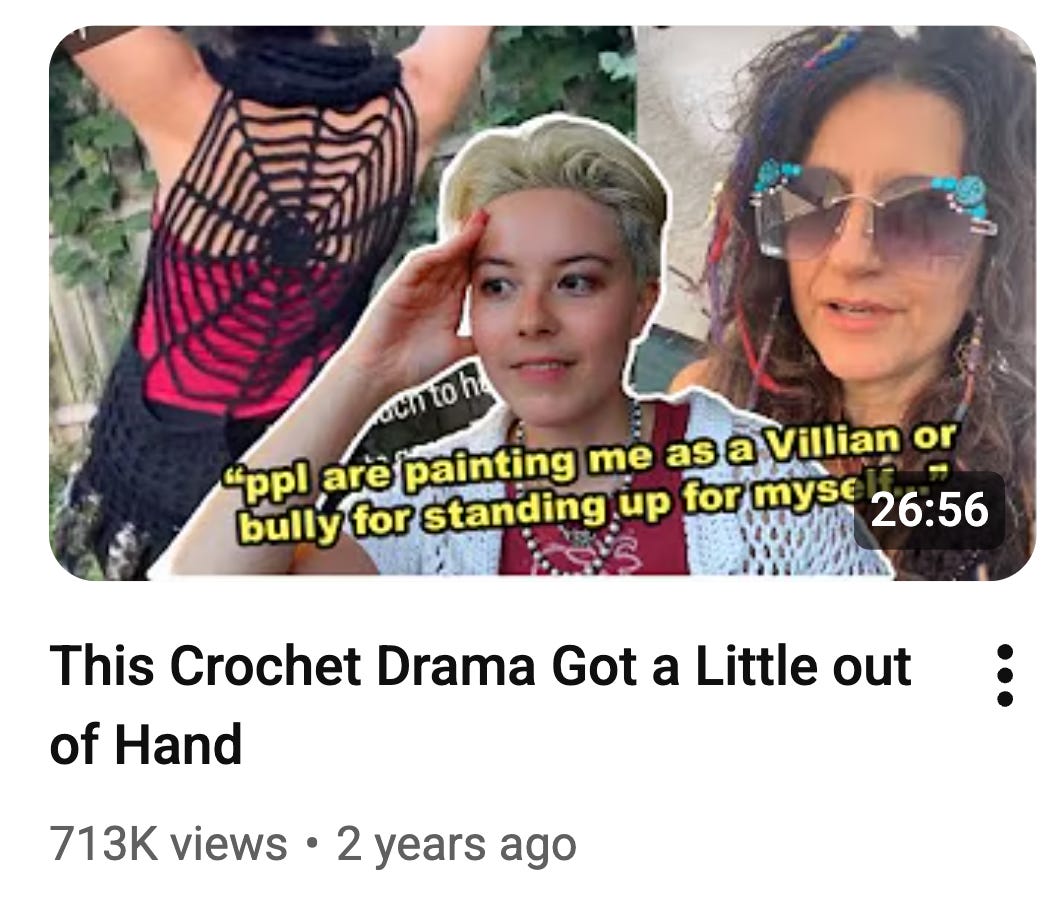
KSENIYA: [Laughs] There’s a whole YouTube channel, “aspen in the moment,” that solely focuses on fiber arts drama. So much of it is about gatekeeping. Doing things wrong, and how dare you use this kind of yarn? Or, Did you really iron your seams open versus closed? Although for the most part, people who do this stuff have a sense of humor and are open-minded.
JADIE: Just not about open stitches.
NICOLE: Do you have a preference for what medium you work in, or different feelings towards different textiles?
KSENIYA: Embroidery is kind of my main thing. Cross-stitch is something that I was doing for a long time, and I find it so satisfying and easier than most other things. But there’s a lot of overlap between mediums, because there’s a pixel element to cross-stitch, but also to crochet and even quilting sometimes. You can make designs using little boxes, and you can translate it all these different ways.
Embarrassingly, I’m not really a knitter. I made a scarf or two and that was about it — it’s never quite clicked with me.
NICOLE: What does it feel like when something does “click” with you?
KSENIYA: That’s a really good question. Crochet was also really, really hard at first, and I didn’t understand it, and that was super frustrating. I don’t know that I can phrase it — when it clicks, I go into this meditative space where I can just keep going and going, and then hours have gone by and I’ve made this thing.
But I’ve also certainly encountered the opposite. I went to this weaving class where I was sweating and struggling and everyone around me seemed to get the hang of it, and it wasn’t gelling for me.
NICOLE: Do you ever abandon projects when they’re just not working?
KSENIYA: Yeah. “WIP,” or “works in progress,” is a really big term in the fiber arts community — like, How many WIPs do you have? Inevitably there’s the pile of half finished sweaters, and that hat that you were making for a baby that’s now 10 years old… [Laughs]
JADIE: What happens when you do finish a project?
KSENIYA: Well, because I don’t sell my work, it depends. I’ve started framing my things. I have a couple on my wall right now.
But what happens at the end, in general? Really, there’s such an emotional low when you get done with a thing, because it’s like, I have spent so much energy, and I have been living with this thing for months. Is it done? Should I keep fiddling with it? If it’s a set pattern, it’s pretty much done when you complete that, but there’s such a tiny depression of: Okay, now I have to find the next thing that will make me feel as good.
Some of the biggest embroideries I’ve done have been gifts for other people. There’s one that I did for my mother-in-law that took about five months, and it always makes me so happy when she shows it off to guests visiting the house. It gets to live on in that way.
I’m not a spiritual person, but I do feel like every piece I make has intention and memories. It’s a tactile way of marking time, and when I give an embroidery to someone, I remember what was happening in my life while I was working on the different sections — like the movie I watched, or something more significant, like when my kid was learning to crawl. The person receiving the piece might not know those details, but I think they feel the warmth.
JADIE: You said your mom was a seamstress, right? Is this something you guys share?
KSENIYA: Yeah, she designed and made clothes. That was her main way of making money when I was little. I think there’s a part of me that hasn’t really ventured into making clothes because I’ve always thought of that as her domain. I’ve mended things. I’ve transformed clothes that I’ve bought, but never made a piece from scratch.
She’s never been big into embroidery. So periodically we talk about doing some sort of collaboration: she would make the piece of clothing and I would decorate it.
JADIE: Do you think she sees fiber arts as fun or grounding in the same way you do, having made a living out of it for so long? Or do you think there’s a difference in approach?
KSENIYA: I think we have a similar feeling about it being something that we need to do in order to feel good. Thinking of her and my grandma, and my mom’s grandma who originally taught her to sew, and that lineage is something that just makes me feel connected to the women in my family. I have a needle and thread tattooed on my arm, and that history is part of the reason — I sometimes touch it, just as a comfort thing.
But my mom is definitely a much more precise person when it comes to cutting and matching patterns. I’m all over the place, and maybe that creates bumpers for the crafts I choose to pursue versus the ones I don’t. Because for a time, I was like, I want to do lacemaking, and I was doing a little bit of it, but boy, does it require another level of precision and focus that sewing a straight stitch or making a bunch of X’s just doesn’t.
JADIE: Is the repetition part of what appeals to you about cross-stitching?
KSENIYA: Yeah. I mean, it has to be the right mix: there’s repetition, but there needs to still be a little variety so your brain is activated. But it’s so satisfying to be like, I have to sew these two pieces of fabric together over and over, and then they come together, and then I have to sew these together over and over again.
NICOLE: That feels like the best way to look at any big project — rather than I have to do this whole big thing, it’s, I have to do all of these little things over and over.
JADIE: Speaking of big things: are you better or worse for fiber arts, and is the world better or worse for fiber arts existing?
KSENIYA: I think overall I’m better. My family, who has to deal with my many piles of yarn and fabric, will sometimes disagree. But I think in the long run it’s something that we, as humans, have been doing since the beginning of time. Embroidery is a protective element for clothes and home decorations in many different cultures — for instance, vyshyvanka in Ukraine. And I don’t think I need to even delve into how valuable it is for the world that we’re able to sit with, and make, an object that is both beautiful and useful.
NICOLE: Is there a particular piece you’re proudest of?
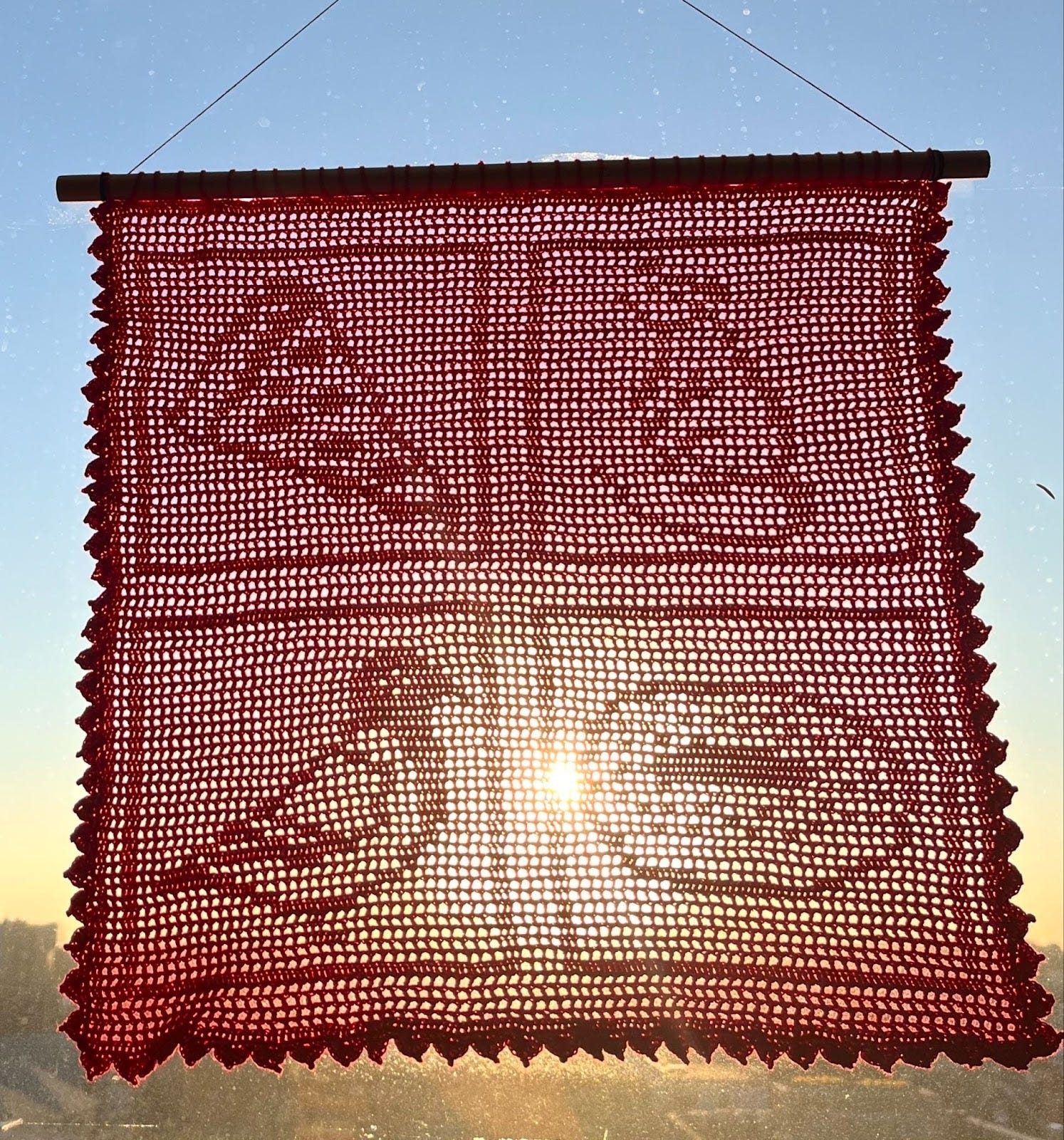
KSENIYA: I’m still so shy about this stuff. Recently, I made this crochet piece that’s sort of like the New York flag…
JADIE: And we pledge allegiance.
did you hear?

