

an arts administrator is normal about titanic (the musical)
caitlin lent on the power of simultaneous singing and sinking
Caitlin Lent is an arts administrator and unrepentant obsessive. Today she is feeling normal about Titanic. No, not that one. Or the other one. For Caitlin, Titanic always refers to the little-known 1997 musical, as performed by the students of Valley Regional High School and by Tony-Award-winning randoms on Broadway. Though the show is lost to culture’s shifting tides, Caitlin holds onto its memory like Rose to Jack. Luckily, she doesn’t know how that movie ends: as a purist, she’s never seen it.
This interview has been edited for clarity, coherence, and vibes.
JADIE: What are you feeling normal about today, and how did you first encounter it?
CAITLIN: Today, and nearly every day, I’m feeling normal about Maury Yeston’s 1997 musical, Titanic: A New Musical, which came out the same year as the Leo-Kate movie, but has absolutely no relation to it in terms of plot — except for some character overlap, because it’s obviously based on history. There’s also the musical Titanique now, but this is a different thing. This was the beginning of Titanic Fever, just not in a form that stood the test of time for anyone. Except me.
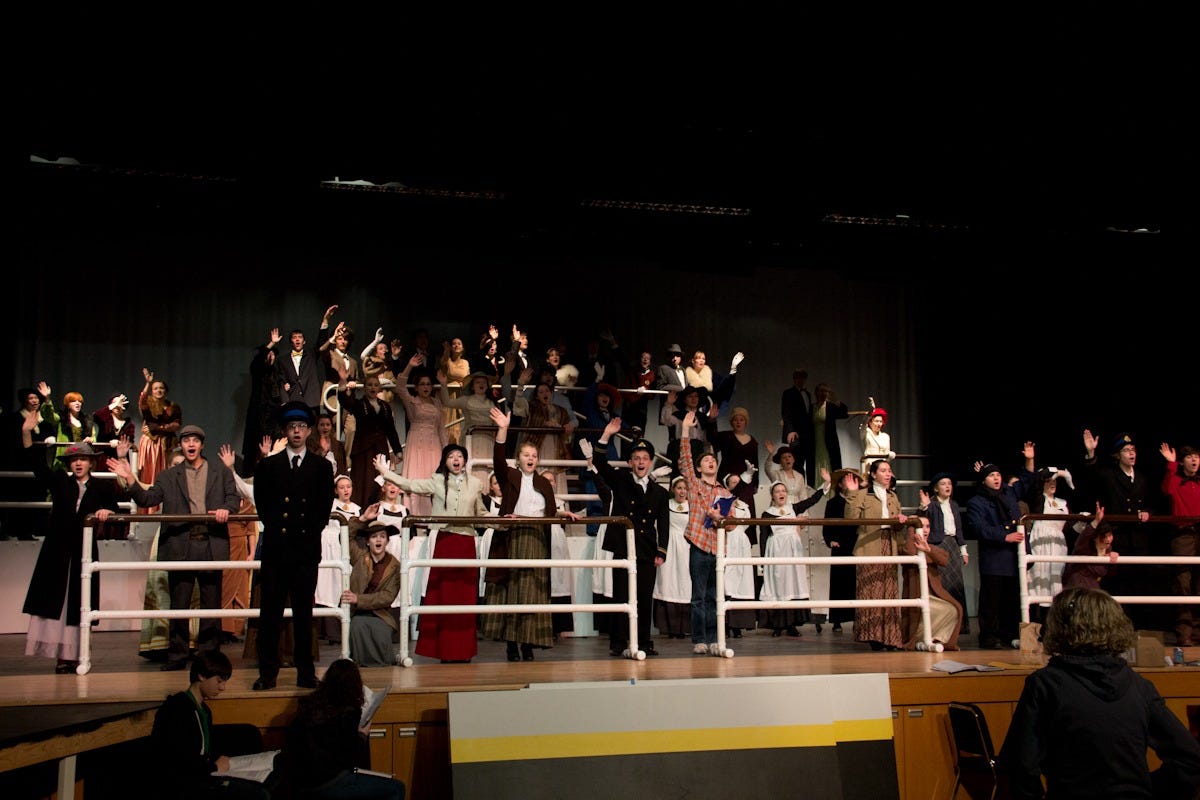
I first encountered the show in seventh grade, when my local high school did it as their musical that year. I was enraptured. It’s an ensemble show, and in my head, this cast of 15-to-18-year-olds is still the pinnacle of sophistication and talent. I saw it on opening night and proceeded to see every performance of it throughout the weekend.
I have no musical talent: I can’t dance, I can’t really sing, I can’t act. But I ended up doing the musical the next year and all four years of high school, because I was like, I want to be a part of something. And I don’t think that I ever achieved the same nirvana that I did watching Titanic, but boy, did I chase it for a long time.
NICOLE: Is the show preserved anywhere? Besides your mind palace.
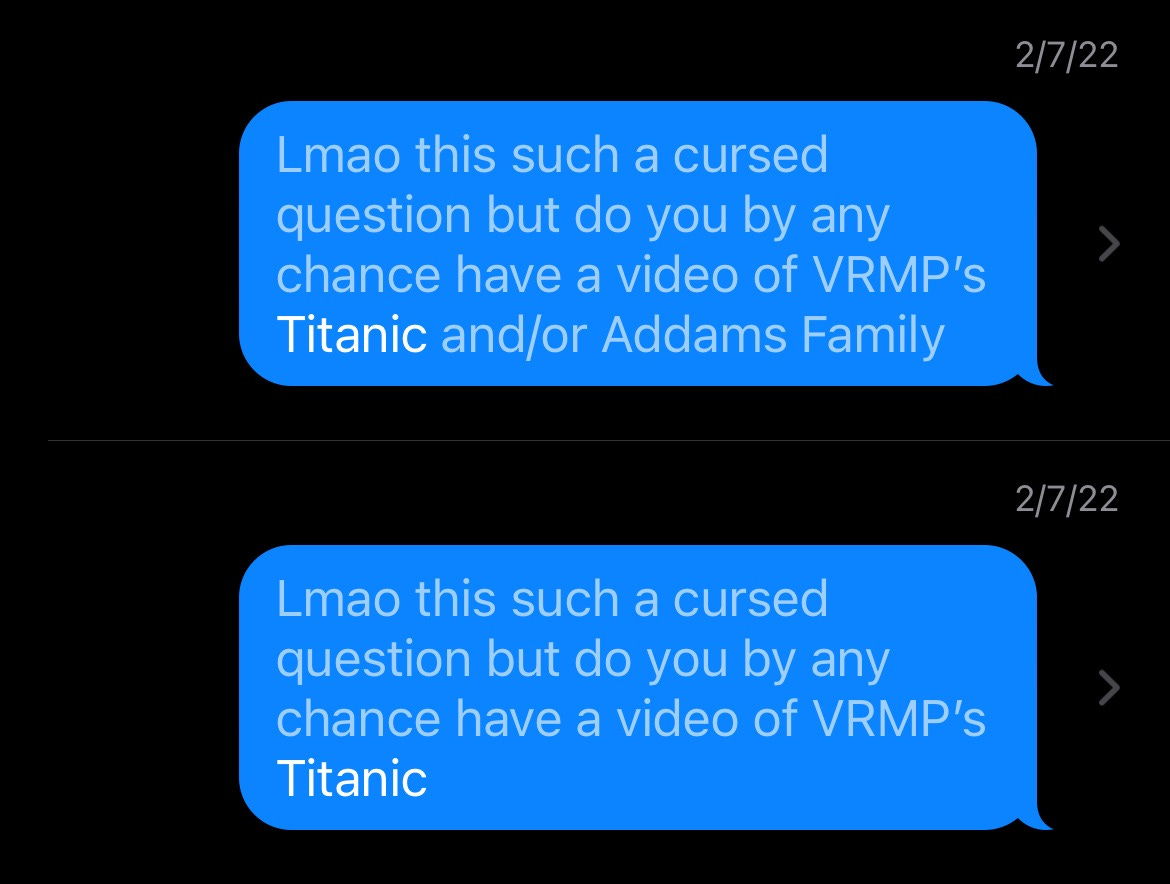
CAITLIN: No, but my friend’s mom was a costume designer for the high school, and for my birthday the following year, she gave me a bootleg DVD of their production — which is one of the best gifts I’ve ever gotten, because I certainly was not supposed to have it. I gave it to someone to borrow that is no longer a friend of mine, and I never got it back, and to this day I’m really devastated. I’d love to see the production again; I want to know if it holds up.
JADIE: There’s a Broadway soundtrack, too, I assume?
CAITLIN: Yeah, there’s an original Broadway cast recording that I listen to, although there are parts that frustrate me because they deviate from the Valley Regional High School production, and I had to get used to hearing the voices of actual adults on these songs. [Laughs]
People don’t really talk about the original Broadway show, but it won the Tony for best musical that year. It was a real flash in the pan with very little cultural impact. It’s had a few international shows — they had a run in London, and in Japan. In 2012, they did a New York City Center production because of the 100-year anniversary of the Titanic. It was a concert-style show, and I was like, It’s going to transfer to Broadway, and it didn’t.
NICOLE: Do you blame Titanic, the movie, for stealing thunder from Titanic, the musical? Would people remember it otherwise?
CAITLIN: That’s a good question. I think the reason these two projects happened around the same time is because they submarined down to the wreck in the 80s, and people finally got to see the champagne that had barnacles and whatnot. I don’t know that the musical would ever have had the same impact as two beloved actors in their prime being very sexy, and it isn’t a love story.
But now that you mention it, I do wonder if the movie impacted [the musical’s] ability to come back into the cultural consciousness, because everyone would assume it was an adaptation and be very disappointed. Although I’ve never actually seen the movie.
JADIE: What? You’ve never seen Titanic?
CAITLIN: No, and I was a film major in college! I have big gaps in my filmic knowledge. But I do think it’s interesting that there are these two ambitious, load-bearing artistic interpretations of the sinking, and that they have some similar themes.
NICOLE: I mean, they called it the unsinkable ship — they sort of wrote their own little themes into existence.
CAITLIN: I wonder if the themes came up as soon as the boat was sinking or if they took some time to marinate.
JADIE: People were holding onto the bow of the ship going, “You know what this is? This is a class-transgressive romance.”
CAITLIN: Exactly. [Laughs]
NICOLE: Now feels like as good a time as any to ask — what’s the musical actually about?
CAITLIN: It basically follows the lives of people in the ship’s three classes, and also some significant individual characters like the captain, the owner, and the builder. There’s a quite pivotal number towards the end where they’re fighting over whose fault everything was, and the captain, who’s sort of our moral center, is like, It’s God who sinks ships. There are three Irish girls, all named Kate, and one of them falls in love with this spunky guy in the third class.
Then there are our upper class characters, who are more of the historical names. There are characters in first class that are clearly loathsome, which feels familiar, and there’s a bit of discussion about the evils of the excesses of the boat, and how our relentless push to be faster and do more is leading to our downfall.
But there are first class characters who also act as a moral center. The Strauses, for instance, are this old-money couple who are quite dignified in their eventual death — it’s a lot of, like, Look how beautifully they carry their money.
Anyway, everyone gets on the boat, and…
JADIE: It sinks?
CAITLIN: Yeah, believe it or not, the boat goes down. Most of our named third class characters get on the lifeboat, which is not really true to what happened, but whatever. In a nice reversal, our dignified Strauses choose to die. Luckily, they had other ancestors who would go on to have King Princess.
What else? Captain, owner, builder all die, I think. Everyone comes out in the last number of the show as these ghostly apparitions, and they give some exposition about the legacy of the sinking. Then there’s this reprise to a song from the beginning about how every age has its miracle — they talk about the Duomo, and Stonehenge — and they’re like, What does it mean that our miracle is at the bottom of the sea?
JADIE: I bet that gagged you in middle school.
CAITLIN: It got me thinking. The show really leaves you with some questions about the folly of man. [Laughs]
JADIE: Does your interest in this show intersect with other stuff you’re into?
CAITLIN: Well, I know the Titanic is a historical fixation for a lot of people — they care about the boat itself and the real people and everything — but my interest in the event itself was always isolated to the musical.
I do love musical theater, though, and I think this shaped my sensibilities there. This show is loud. Every song feels like it’s the end of the act. It’s a very ambitious ensemble drama about a real event, similar to Les Misérables or Ragtime, both of which I also love. I think it’s very silly and funny when there’s a historical namedrop, but I feel even more fondly about the characters created for the show who are our little, human-scale windows into these historic events.
History was my favorite subject in school, but I always loved media that teased out these very small historical stories. I’m just spurting off clichés at this point, but I like knowing that people have always felt this way and people will always feel this way. Like, class conflict, the desire to start something new, narratives of immigration — that stuff goes back way further than what we put on the stage now, you know?
NICOLE: A big ensemble musical does seem like a good format to explore those themes, honestly.
CAITLIN: Yeah. I do find comfort in a very neat but sweeping narrative — you can make broad strokes when you don’t have to fill a screenplay, and when people are singing at you, it makes it easier to have moments of expository soliloquy. And some of the show is so hamfisted, like, Wow, we built this ship with 14 tons of steel that could never break. Someone expressing that in a movie would sound a lot cornier than in a musical, where you’re used to a certain suspension of disbelief and a higher level of…schlock, I guess. And I really like schlock. That’s something that I enjoy across all media.
I think musical theater is kind of bad inherently — which I love for it to be — but I think this is a good show. The quality probably varies depending on the staging of it, though; I’ve seen videos of the concert productions, and I don’t think those hold up. I need to be immersed in the world of the boat for it to work for me.
With Titanic, and with many musicals, I sometimes prefer to listen to the cast recording versus seeing it in person, because sometimes I find it excruciating to watch when it’s people moving around on a little stage, and we have to pretend that this wall is both the nursery and the coal room. I like creating this world in my head — my mind boat.
NICOLE: We usually ask how someone who wanted to get normal about a topic would jump in, but it sounds like the routes to access might be limited here.
CAITLIN: Yeah, you’re gonna have to travel back in time to 2011 and take a trip to Valley Regional High School. Or you can find a recording of the Broadway show, or set aside a couple hours and listen to the album. It’s transportive. And there was a filmed version of the show in London, which you can watch through some arcane British streaming service.
And whenever there’s a new staging of it, I hope I’ll be the first to know. I’m going to set a Google alert now. Or the producers can hit me up directly. But the canon version for me is the one from 2011.
JADIE: Last question — are you better or worse for knowing about Titanic: A New Musical, and is the world better or worse for the show existing?
CAITLIN: I think I’m better. I think I sometimes succumb to a bit of fatalism and cynicism, and loving something so incredibly silly and earnest reminds me that there are some universal truths. And it takes me back to a discrete moment of my life where it felt like things were beginning — and I bet it felt like that for a lot of people on the Titanic before they went down. [Laughs] So it’s also a reminder that nothing is promised. And both of those things can be true at the same time.
Is the world better? I mean, again, as far as I’m aware, a lot of the world doesn’t know about this show, so I don’t know that it’s had much of an effect. But I do wish more people would discover it, because I think there’s some neoliberal or maybe conservative mom who would watch this and be like, You know what? Immigration is part of our country’s story. It presses against the edge of things that I think are quite radical, especially about how the continued delusion of the American dream makes people do crazy things.
So — I don’t know. Just pull up the cast recording, and take yourself on a ship, and I hope you don’t sink. But you will.
did you hear?

