

a theater critic is normal about the french revolution
hailey bachrach on radical histories, reactionary musicals, and gay-ass revolutionaries
Hailey Bachrach is a theater critic, writer, and former scholar whose life trajectory can be traced back to watching a VHS of the Les Misérables 10th anniversary concert at age 12 (many such cases!). Today, she is feeling normal about the French Revolution, a particularly timely historical blip that, Hailey argues, has yet to receive the Hollywood adaptation it deserves. If and when it does, we’ll know that “something has shifted” in the sociopolitical landscape; in the meantime, if Timothée Chalamet’s agent is reading this, we have a role in mind for him (playing gay is required).
This interview has been edited for clarity, coherence, and vibes.
NICOLE: What are you feeling normal about, and how did you first encounter it?
HAILEY: The thing that I've been feeling really normal about lately is the French Revolution. I first started to care about this in relation to another topic that I also feel really normal about, which is the musical Les Misérables. I became very passionate about Les Mis as a teenager, and one of the things that became a favorite hill to die on is that it is not set during the French Revolution — an easily discoverable fact that people often miss.
That led me to be like, Okay, well, this is not about that, but what was going on there? And I got really into reading about the French Revolution when I was, like, 14 years old. I took French in high school and I studied the “long 19th century” my first year of college because I thought maybe I wanted to study French history, and then I didn't. But it’s still something that I have a lot of passionate feelings about, and increasingly I feel like it's like a time period that speaks to the present in a lot of important ways.
JADIE: Would you say you’re inspired by the French Revolution?
HAILEY: I feel like if I say I'm inspired by it, I'll get arrested. [Laughs] I think it’s a couple of things. I think that one of the reasons I didn't end up becoming a historian is that I get really fixated on the stories of individual people, and less so on the big historical currents. There are just so many interesting figures within the French Revolution. The main figures are a really tight-knit social circle of people who all knew each other, and there's tons of weird interpersonal drama that culminated in everyone, like, guillotining their friends. So it's just, on a personal level, extremely dramatic.
When I say the French Revolution has things to say about the present…we all love to be like, Yay, eat the rich, but the fact that there’s never been a really good, nuanced English- or even French-language movie that depicts these events in a way that’s actually engaging with the idea of revolutionary violence and isn’t just like, aw, poor Marie Antoinette — I think that says something about our culture’s readiness to actually confront these ideas as more than a meme.
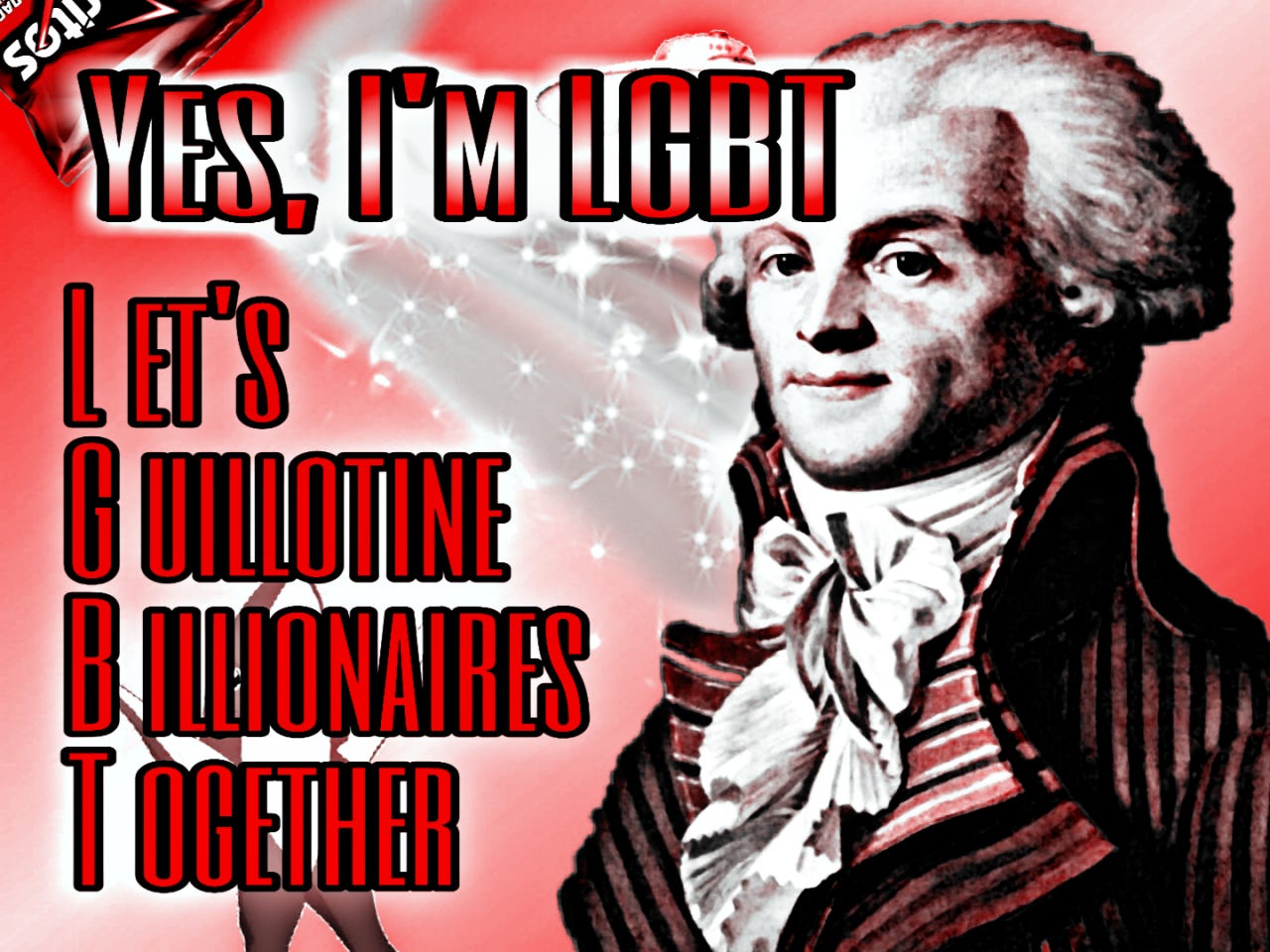
And the thing that I’ve been feeling really normal about in relation to this is my theory that when we have a good French Revolution movie or TV show, that will mean the culture is in a place where some big political change might be about to happen. I realize that's a completely deranged thing to say, but that's my theory of the world.
JADIE: Do you think that’s on the horizon anytime soon? Is there anything that suggests we’re approaching a perfect French Revolution movie moment?
HAILEY: I think yes and no. I think that on the one hand, historical storytelling is so conservative even when it's trying to be progressive. For instance, I really hate the musical SIX. I feel like it’s really reactionary deep in its soul, even while it’s putting on this veneer of feminism, and I think it’s this perfect example of how, when people are telling stories about history, they get trapped in these limited ideas about what’s possible. SIX can’t envision feminism in a way that’s not saying, Yeah, but wasn’t it kind of good that Henry VIII’s wives got to be girlboss queens? It doesn’t know how to say anything about power or patriarchy in a serious way, and that’s something that I feel is dragging down so many historical narratives.
On the other hand, we do have a culture where a healthcare CEO got shot and people were like, Was that bad? So I think there’s things bubbling up right now, and this sort of anger — wait.
Sorry, my TV just turned on by itself.
NICOLE: They’re listening…
HAILEY: They’re listening! [Laughs] Anyway, there’s this sincere, populist anger in the culture right now, on all sides of the political spectrum, that’s getting expressed in really bad ways. Ironically, that’s kind of what we see in the French Revolution, too: there were things that were good and progressive and important that happened, and then obviously, those got turned to these reactionary and violent ends. I think it goes to show that everyone can use reactionary violence; it’s not only the “good guys” or the “bad guys.” There are things in the culture now that feel like they’re reaching towards this question of what happens when inequality and injustice gets so profound that people are just like, We can't take this anymore. We’re going to force change to happen by whatever means we can lay hands on.
The reason I say something as silly as “a movie will change the world” is that I think when something can actually break into the mainstream popular culture and have that radicalism baked into its storytelling, that’s a sign that something has genuinely shifted.
NICOLE: Do you think Americans are even capable of making a radical movie about revolution?
HAILEY: I don’t know — I think we, as Americans, need distance from that kind of sentiment, right? The most popular telling of our own revolution is also this fundamentally very conservative, reactionary thing. So clearly we can’t tell that kind of story about ourselves yet, but maybe we could tell it about other people, like the French, and it would feel safe enough to seep in.
The other story that I feel like this is true of is the Haitian Revolution, which happened around the same time and was a slave revolt. It’s this incredible story that absolutely no one tells — and someday, when someone tells that story, something will be happening.
JADIE: It sounds like you’re normal about histories of revolution, or radical histories, even beyond France.
HAILEY: One of my great passions is definitely narratives of history, and how we tell stories about the past. And I think revolutions are exciting, right? As someone who gets really invested in the people who are the quote-unquote “characters” in a historical narrative, revolutions set up these heightened moments where people act in these really dramatic ways. So they’re exciting as a history and as a story.
Something that I also find fascinating in the history of revolutions is that when you learn about them, you realize that these ideas that feel really modern have a really long history. Another mini-revolution I’m really fascinated by is the Levellers, which was this moment during the English Civil War when the English had their turn at killing their king. You had this movement within the army that was basically 17th century socialism, and when you read the things that the Levellers wrote and the demands they made, you feel like it’s about 300 years earlier than you’d expect to hear all of this.
JADIE: Does the interpersonal drama within revolutions that you were talking about earlier feel “modern,” too?
HAILEY: Totally. When I was learning about the French Revolution, there was this moment I got really obsessed with. Basically, there was this guy called Camille Desmoulins, and he’s credited with, on Bastille Day — the day that the revolution kind of kicked off — supposedly jumping on a table and giving this stirring oration and becoming one of the first celebrities of the revolution. He was a journalist, and he printed these really violent pamphlets about how we should hang the aristocracy from lantern hooks.
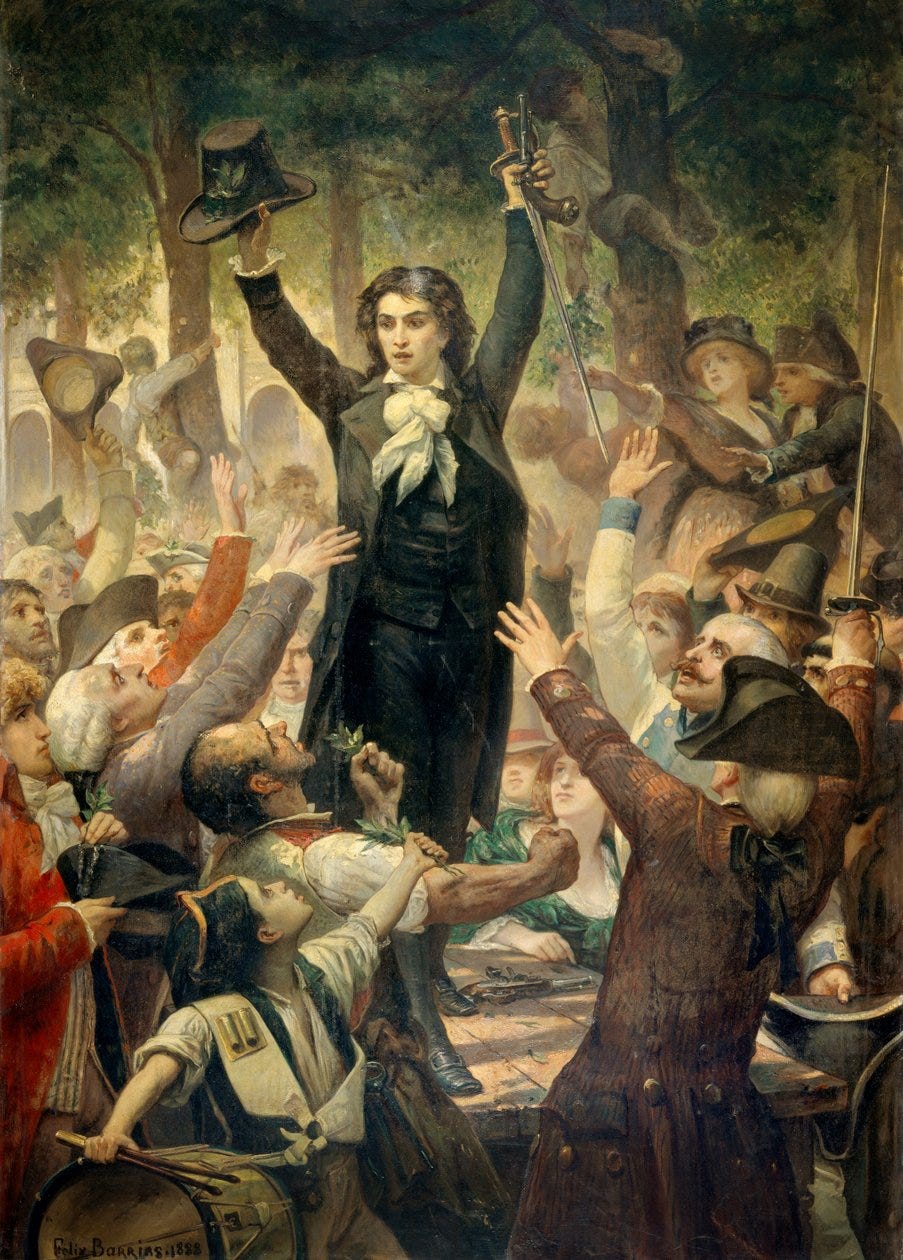
Again, it’s just the perfect character: he spoke with a stutter, so he was a bad orator except for when he’d get really passionate, and then it would go away. But he was also this incredible writer, and he was longtime best friends with Robespierre. And as Robespierre became more of a leading figure within the revolution, Desmoulins started to lose his nerve about some of the violence he’d been advocating for, and he started getting a little more moderate in the things that he was writing and speaking about. And Robespierre started to be put in the position of being like, How long can I keep defending my friend when I’ve participated in silencing other people who have said similar things? So there’s this amazing falling out happening at the center of everything.
Desmoulins and some of his allies did end up getting guillotined, and there are questions about how much Robespierre tried to prevent that from happening, or tried to talk him down and get him to a place where Robespierre could protect him.
JADIE: I’m sensing a complex homoerotic bond.
HAILEY: Exactly. You get it. You see the vision. Actually, when I was in college, I wrote a play about the brief couple of days where it becomes clear that the political faction that Desmoulins is a part of is going to be arrested and killed, and the central tension is whether his friendship with Robespierre will be enough to stop it. And obviously it wasn’t in the end, so what was that relationship ultimately?
NICOLE: That sounds compelling.
HAILEY: The plot I didn’t make up, so that part I will agree is super compelling. Was the execution good? No. [No pun intended, we assume.]
NICOLE: Going back to your initial interest in Les Mis — the idea of a musical as a vessel for translating historical emotions and ideas is interesting to me, especially because you’re saying SIX fails in that respect. Do you think a musical might be the ideal medium for a good French Revolution story, maybe because it allows for such raw displays of emotion?
HAILEY: So Alain Boublil and Jean-Max Rivière actually wrote a French Revolution musical in the ’70s, and it’s terrible. There’s so much weird electric guitar — I really cannot recommend it. It’s in French. Inexplicably, it’s never been translated.
That's such a good point, though, and I think that a musical would be awesome, although I have mixed feelings about it. I think a musical would be incredible for capturing certain ideas. For example, there’s one moment in Hamilton that I do love, despite having shit on the show before, which is the transition between “The Schuyler Sisters,” where it’s like, Yay, revolution’s so fun, to that “thirty-two thousand troops in New York harbor” lyric. It lets the horror of the moment and the consequences of what they’ve been doing land for the audience in this really visceral, elegant way. And I think if you got a writer who could achieve moments like that, a French Revolution musical would be so good.
But I also think so much of the problem with the way the French Revolution has been depicted is that when you get wrapped up in the feeling of it, it stops being about the bigger questions. I love feelings, as I said, but the revolution always gets dismissed as, Yeah, they just went crazy and started killing everybody. They were too power-hungry and violent and emotional. And maybe a musical would actually just feed into those ideas.
I think it's one of those time periods where actually, the problem isn't that it needs to be humanized, which is so often the case: people have this stuffy vision of the past, so you write a musical as a way to remind everyone that these were real people. On some level I think the French Revolution does need that — Robespierre is not some monster, et cetera — but it also needs this layer of, Yes, these were real people with big feelings, and: they were behaving in a rational way and making deliberate choices; they weren’t just killing people.
JADIE: When you were at your peak normalcy about the French Revolution, how were you engaging with it? Were there other people who were into it in the same way?
HAILEY: This was pre-podcasts, so I was doing a lot of reading. These historical figures are people who leave a massive paper trail, so there’s endless amounts of their own writing to read. And yes, there is absolutely what you could call a “fandom” of the French Revolution — often, it’s people who take a more careful and nuanced view of events than a lot of English language historians do.
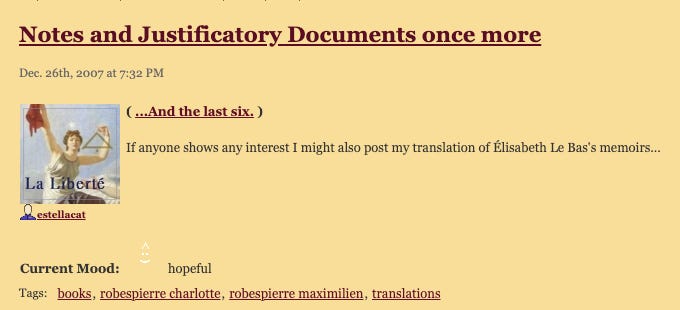
On LiveJournal back in the day, there were communities of people who would translate stuff and share it. “Fan” is maybe a weird word to use for them, but there is an enthusiasm that leads people to become amateur historians, I guess you’d say, and many of them were quite young, including myself. I’m certain that this type of thing still exists; I’m just not as engaged with it anymore.
NICOLE: If someone wanted to become normal about the French Revolution, where should they start?
HAILEY: This is so hard, because as I said, I’m not super up to date, and so much of what’s been written in English is not very good. If you can handle a Hilary Mantel tome, there’s A Place of Greater Safety. I also think that the Revolutions podcast is really good — they did a French Revolution series that’s quite balanced, and the podcast covers a bunch of other revolutions as well.
But really I think it’s one of those things where, since there’s so much out there, you’d almost want to start a Wikipedia deep dive and just be like, What strikes me as weird and cool? or Who’s a person who did something interesting? Inevitably, it will turn out that there’s a whole wild story behind basically anything.
JADIE: And eventually you end up on LiveJournal…
HAILEY: And eventually you end up on LiveJournal, where the only English translation of someone’s letters was done by a 17-year-old in 2004.
JADIE: Last question: are you better or worse for knowing about the French Revolution, and is the world better or worse for the French Revolution having happened?
HAILEY: I’m definitely better for it. I think it’s a great thing to have encountered as a teenager because it taught me so much about the idea of historiography, which was formative in terms of shaping what would turn into my career as a researcher. And I learned French because of it.
Is the world better? I think it’s really hard to say, and there are some really amazing alt histories about what would have happened if the French Revolution had succeeded or never happened. Unquestionably it did really important things, like sparking the Haitian Revolution and the abolition of slavery in Haiti — although then Napoleon kind of walked it back, so that’s not ideal. I do think it set up this fear of popular uprising in the rest of the world, and in our tellings of it, you see that fear so profoundly. So maybe it’s good that the revolution happened, but what’s bad is the way it ended, because it left an opening for people to reshape it into a cautionary tale and defang the power of what was actually happening: people overthrowing a centuries-old monarchy and almost making it stick.
I definitely don’t agree that the revolution was bad just because Marie Antoinette got her head chopped off, and we’re very sad for her or whatever.
JADIE: I’m not that sad for her.
NICOLE: Me either.
HAILEY: I’m also not that sad for her. There’s this quote by Mark Twain from A Connecticut Yankee in King Arthur’s Court, where he says:
“There were two ‘reigns of terror,’ if we would but remember it and consider it; the one wrought murder in hot passion, the other in heartless cold blood; the one lasted mere months, the other had lasted a thousand years; the one inflicted death upon ten thousand persons, the other upon a hundred millions; but our shudders are all for the horrors of the minor Terror, the momentary Terror, so to speak; whereas, what is the horror of swift death by the axe, compared with lifelong death from hunger, cold, insult, cruelty, and heart-break?”
That, fundamentally, is the idea that my fantasy French Revolution film, movie, musical, TV show, whatever, would get across: the idea that the violence of resistance is less than the violence of the current system, and like, maybe it’s bad to punch a Nazi, but isn’t what the Nazi’s done way worse? And how can we, in the present, learn to see the violence that’s being perpetuated against us as great and terrible and worthy of retribution?
JADIE: I mean, I’m sold. Someone needs to pitch this show to HBO.
HAILEY: HBO’s a good shout — Timothée Chalamet could be in it. Yes, please join me, everyone, in this yearning for a thing that probably-maybe will never happen.
did you hear?

